
Sustainability Has A Budget Line. It's Just Not Where You'd Expect.
The reusable water bottle and the chiller replacement are funded by entirely different budgets, championed by different people.

Every hotel has a sustainability strategy now. A page on the website, a few paragraphs in the annual report, a photo of solar panels by the pool, a QR code instead of a laminated menu. Genuinely good things, some of them.
But whose budget paid for that?
Because there are two very different answers, and they produce two very different hotels.
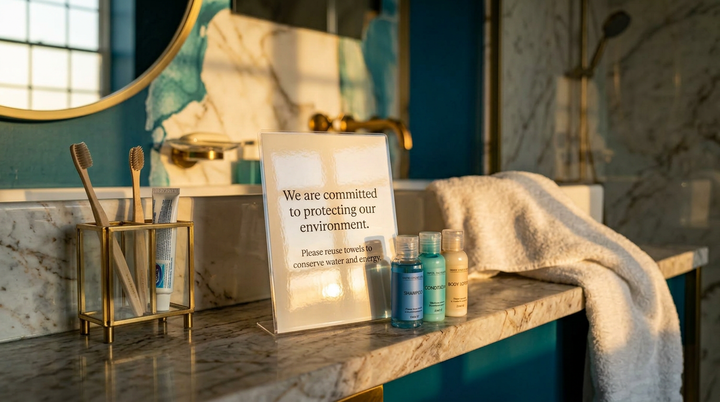
If the money came from marketing or corporate communications, you're looking at the visible stuff. The reusable water bottle with the logo on it. The signage. The annual report photo. Cheap to fund, easy to greenlight, and it earns whoever approved it a slide in the next town hall about "our commitment to the planet."
If the money had to come from engineering or capex, you're looking at the stuff nobody photographs. A chiller replacement that actually cuts energy use. Better insulation. A waste system that does more than look tidy in a brochure. These cost real money, take real time, and deliver zero PR value on the day they're approved - the value shows up two years later in a utility bill.
It's the same reason the cheaper, greener suppliers sitting in every hotelier's inbox rarely make it past procurement. Real change usually means someone has to fight a system built for something else. The visible stuff doesn't ask that of anyone.
Guess which one wins when the two compete for the same finite budget.
There's a real name for this pattern in ESG research: symbolic versus substantive action. A 2026 academic review of 62 studies on the subject draws the same line - initiatives built for perception with minimal material impact, versus ones involving real investment and structural change. Turns out the reusable water bottle and the chiller replacement aren't just different in cost. They're a documented, studied category apart.
This isn't a story about hotels not caring. It's a story about who gets credit deciding what gets funded. The visible initiative has a champion - someone whose job improves the moment it's approved. The invisible one, the one that actually reduces consumption, usually doesn't have anyone whose bonus depends on pushing it through. It just competes against every other capex request on a spreadsheet, and loses to the request with a better story attached.
This is the same pattern behind every sustainability question on an RFP - four acceptable answers to choose from, and nobody ever checks which one you picked. The paperwork gets filed either way. The bottle and the chiller both "count" the same on that form.
So next time a hotel proudly tells you about its sustainability program, the sharper question isn't "what are they doing." It's "who signed off on the budget, and what did they personally get out of saying yes."
xoxo, Bored Hotelier 😉
Source:
Symbolic Versus Substantive ESG Practices: A Systematic Review and Integrative Framework, Corporate Social Responsibility and Environmental Management, 2026
FAQs
What counts as greenwashing in hotels? Anything that markets a hotel as sustainable based on the cheapest, most visible fraction of what "sustainable" would actually require. A reusable water bottle and a QR-code menu are real things. They're also the two initiatives a marketing budget can approve without touching the systems that actually consume the energy.
Is greenwashing illegal? Increasingly, in some jurisdictions - regulators have started treating vague or unsubstantiated environmental claims as a consumer protection issue, not just a PR embarrassment. But most of what happens in hotel sustainability marketing doesn't need to be illegal to be misleading. It just needs to be technically true and strategically incomplete.
What is ESG capex? The sustainability spending that doesn't show up in a press release - chiller replacements, insulation upgrades, waste systems. It comes from an engineering or capital budget instead of a marketing one, competes against every other capex request on the same spreadsheet, and pays off two years later in a utility bill nobody photographs.
What are hotels actually doing for sustainability? Depends entirely on which budget you're asking about. The marketing-funded version is signage, bottles, and a paragraph in the annual report. The capex-funded version is the equipment upgrade that actually reduces consumption. A 2026 review of 62 ESG studies has a name for the gap between the two: symbolic versus substantive action - and most hotels are doing more of the first than the second.

Comments ()